On a recent trip to Seattle Orchid, I purchased a second mounted orchid. The new addition seen on the right is a Neofinetia falcata. It joins my Sophronitis cernua on the left, a gift from my parents. Both live in the master bath.
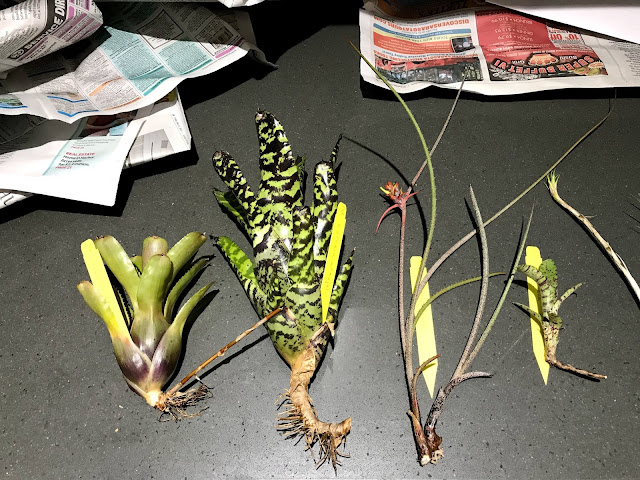
Just before leaving for Denver last week to attend the Garden Bloggers Fling, I was in the process of finalizing an order for some hard to find bromeliad species. My visit to the San Antonio Botanical Garden last December inspired the purchase; I admired the garden's display of epiphytic bromeliads growing on tree branches, small pitchers connected by a dramatic network of long stolons. Below are the new arrivals from Michael's Bromeliads, all arrived neatly wrapped in newspaper with handwritten labels. If the offsets/pups look undersized, they should; most are mini Neoregelia species with a couple of small Aechmeas, plus an Acanthostachys for fun. Apologies for the terrible lighting. This was the bromeliad I most wanted but seemed impossible to find in the US, Neoregelia pendula var. brevifolia. Acanthostachys strobileacea arrived already in bloom, or perhaps fruit? While bromeliads are monocarpic, an unbloomed offset was also attached, so the bloom was not a cause f...
I am back in Texas visiting family and enjoying the local flora, mostly around Comal County. The native cacti in this area are generally Opuntia species and Echinocereus reichenbachii (my ID, so take it with a grain of salt). I am particularly fond of E. reichenbachii, seen below. And a small village of E. reichenbachii. The size and shape of the cactus varies but always appears attributable to growing conditions in each site. That was until today, when I found a crested form! From another angle, note the three normal growths at the top and the mutated squiggle towards the bottom right. Nurseries frequently offer crested forms of cactus and euphorbia, but I have never discovered the mutation growing naturally in the wild. Judging by looks, there is not much economic potential (and obviously I would not remove it in any case). The plant certainly looks very healthy, despite its unusual growth pattern.
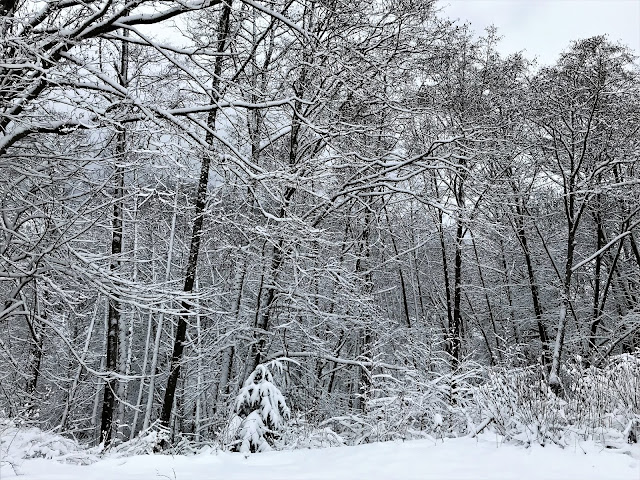
After a very mild, sunny winter through the end of January, the weather fell apart in February, turning cold and snowy. Four to six inches fell overnight, and without much else to do, dogs and people took two walks in Carkeek Park. Around 10 am Saturday, starting the first walk under cloud cover... Paul and Kona, walking ahead... Several trees were down across the path, and I doubt these trees are supposed to lean this much (walk quickly)... The snow may be depressing in the garden, but it is certainly beautiful in the park. I will post photos of our second walk in Carkeek tomorrow .


Comments
Post a Comment